
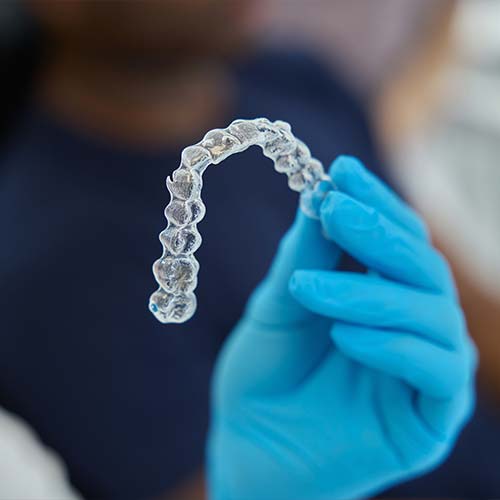
Orthodontic Treatments
A dental specialty called orthodontics investigates, prevents, and corrects developmental alterations, shapes the dental arches, and positions the jaws to restore the morphological and functional balance of the mouth and face and enhance facial aesthetics. Orthodontics attempts either displacement of the whole set of teeth (dental arch) or occlusal normalizing of the teeth (chewing surface), in particular, to correct functional chewing abnormalities. The contact interactions among the teeth of several arches—that is, between the upper and lower teeth—form the basis of congestion. Decoupling underpins decoupage. Mostly, corrective treatment targets a consolidated malocclusion. Mostly three different kinds of devices are utilized in this kind of treatment:
Functioning Tool
Regarding the functional equipment, we refer to several removable devices meant to adjust the position of several muscle groups influencing the function and posture of the jaw in November, so extending its length. Usually, they are advised during mixed or transient teething. These are tools that first just bring about functional improvements but subsequently cause structural alterations. Functional devices generate tooth displacements and modify the direction and strength of November muscular forces. These devices produce changes in the bone supporting the teeth and an inclination of the teeth. Removeable Tools The patient can remove these devices to clean them, but once they are put in place they are tightly bonded to the teeth. Among these tools are screws, belts, springs, etc. It applies controlled pressures to the teeth that the active mechanical elements, like, will be displacing. These forces have nothing in connection with the forces produced by the movement of the November muscles participating in the actions of chewing, swallowing, phonation, among others; they are totally artificial or mechanical and act directly by displacing the teeth. Particularly the upper half, notably “cross bites” and minor crowding, when is this? Removable devices, sometimes known as “plates,” are quite helpful for the jaw correction. Apart from expansion, it is advised for quite particular tooth movements.
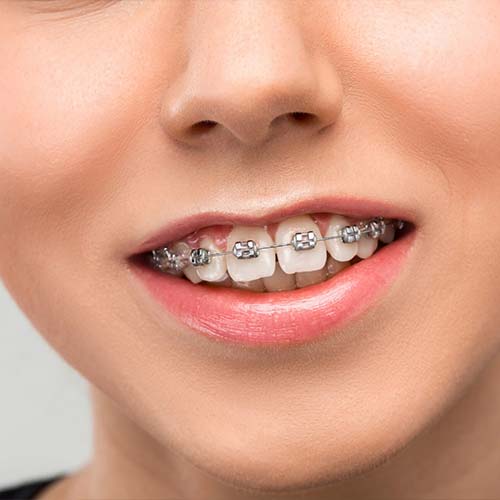
Fixed Devices—Brackets
This type of orthodontics combines metal or ceramic materials and metal arches crossing teeth with brackets adhered to them. Unlike other devices, stationary devices allow every one of the teeth to migrate independently in any direction. According to the specified treatment plan, fixed devices need a rigorous technique through the exact insertion of tapes and cemented braces on each of the teeth, as well as a succession of complex arches to accomplish the required displacements, to get accurate results. These devices are advised in cases of malpositio?n teeth, turned teeth, closed gaps and made simultaneous all types of actions. One can see braces, metallic or aesthetic ones like ceramic ones, which are translucent or transparent and stick to the outer surface of the teeth, so absorbing their color. Lingual orthodontics let them be positioned on either the inner or outer side of the tooth. With fixed appliance orthodontic treatment, other medications, as well as the implementation of oral hygiene, gingivitis and gum bleeding more may be associated. Therefore, it must be a good periodontal status of people with orthodontic treatment. More complicated (especially the interdental areas) will thus be associated. and continuous observing all during the treatment. Plaque inflammation with a thorough description of the relationship between diet-related recommendations, to record existing teaching about oral hygiene techniques and products, and their efficacy must be an organized program of monitoring. This is a natural component of orthodontic treatment. It ought to be used all along the course of treatment. Oral health should be especially taken care of during orthodontic treatment; brushing correct teeth and creating tools specifically for orthodontic users should also be given great attention.
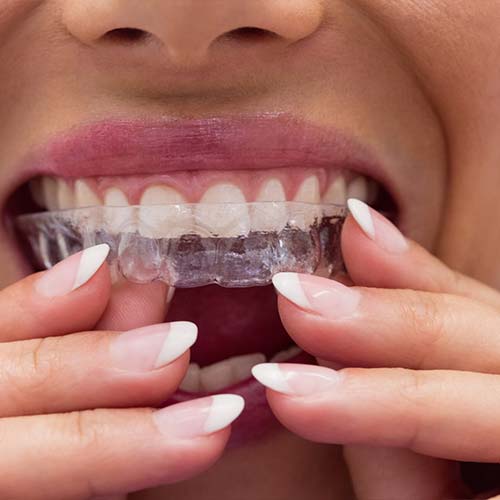
Invisalign
Orthodontic therapy uses the transparent aligner Invisalign. Invisalign gently moves your teeth into a desirable position using a set of custom-made, transparent plastic aligners unlike conventional metal braces.
Important characteristics of Invisalign:
Less obvious than conventional braces since the aligners are constructed from a clear plastic substance.
Easy oral hygiene can be achieved by removing the aligners for cleaning your teeth, drinking, and eating.
With less soreness and irritations, Invisalign aligners are often more comfortable than metal braces.
will advance to the following pair of aligners.
How does Invisalign operate?
A dentist or orthodontist will evaluate your teeth and jaw to ascertain whether Invisalign is a candidate for you.
Your teeth will be photographed to produce a computerized model.
Your orthodontist will create a customized treatment plan including the projected treatment time and the count of aligners required.
Aligners: Your treatment plan will guide the fabrication of a set of clear aligners.
You will wear every pair of aligners for a designated period—usually one to two weeks. Your teeth will move and you
Benefits of Invisalign:
Popular among adults and teenagers seeking a more covert orthodontic treatment, Invisalign’s clear aligners are less obvious than standard braces.
With less soreness and irritations, Invisalign aligners are often more comfortable than metal braces.
Convenience: The detachable aligners let you eat, drink, and normally wash your teeth.
Shorter treatment time: In some circumstances Invisalign can be finished in less time than standard braces.
Invisalign’s limitations are:
Not appropriate for all cases: Invisalign might not be appropriate for difficult orthodontic issues.
Compliance: To get best results, follow advised aligner wear guidelines.
Cost: Generally speaking, Invisalign therapy is more costly than conventional braces.
